During World War II more than 40 different bombers and jet fighters have crashed within de county borders of Hollands Kroon. The crashes were mostly on land, in the Ijssel lake and the Wadden sea.
Few crew members were arrested after using their parachute to reach the ground, others could flee with the help of the Resistance. However, the majority lost their lives and did not return home safely to their family and loved ones.
This remembrance post was unveiled on September 14th 2019

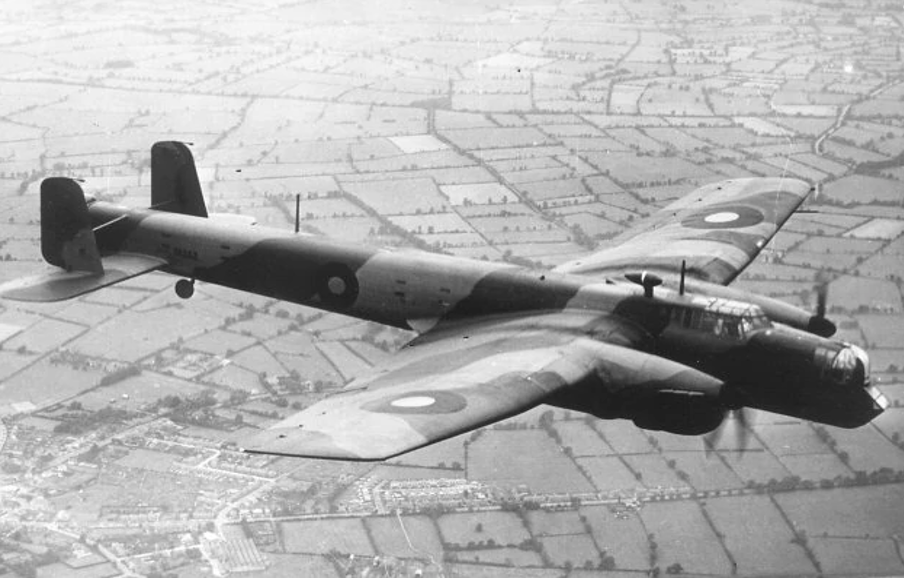
Whitley T4279

Crash information
On 12 June 1941, 23.12h, the Witley bomber took off from Topcliffe airport in England. This particular evening 227 bombers took off from England to several missions above Germany. The Whitley’s target was the shunting yard of the German city Schwerte.
At 01.10h the bomber crashed on its way to Schwerte. An eye witness stated that during his patrol he witnessed the shooting by the night hunter of Flugzeugfuhrer Oberleutnant Egmont Prinz zur Lippe-Weissenfeld. The aircraft immediately set fire, before it broke down in many pieces and crashed nearby Wagenpad. All crew members lost their lives.
Donald Keith McFarland
Sergeant
Pilot
26 years old
United Kingdom
Kenneth Rowland Wainwright
Sergeant
Second Pilot
21 years old
Canada
Geoffrey Vivian Heslop
Pilot Officer
Observer
22 years old
United Kingdom
Lawrence Stanley Dyer
Sergeant
Radio operator
20 years old
United Kingdom
Douglas Howard John Pingel
Sergeant
Gunner
18 years old
United Kingdom
Visit of the Perry-Wainwright family to the remembrance post at the Wagenpad
On a windy Sunday morning, 21 September 2025, the Hollands Kroon Remembrance Posts Foundation received special visitors from Canada. From Toronto, Ross and Elizabeth Perry-Wainwright travelled to the Wieringermeer to visit the site where, during the night of 12 to 13 June 1941, Whitley bomber T4279 crashed.
Also present was the Smit family, the original farming family of the Wagenpad farm where the aircraft came down.
For Elizabeth Perry-Wainwright, the visit was deeply meaningful. Her mother and Sergeant-Pilot Kenneth Rowland Wainwright were cousins and childhood friends. Kenneth was the only child of his parents, who had emigrated from England to Toronto in 1919. He volunteered for the Royal Canadian Air Force in July 1940 and was trained as a pilot within eleven months.
On 12 June 1941, Kenneth took off as second pilot from RAF Topcliffe with his crew for a bombing mission to Schwerte. The aircraft was shot down over the Wieringermeer by a German night fighter and crashed in several parts on and around the Smit family’s land. All crew members were killed.
The Perry-Wainwright family not only visited the crash site but also shared valuable documents and photographs, which — with their permission — we may show on our website. These include, among others:
the Wainwright family gravestone with Kenneth’s name
the attestation paper Kenneth signed in his own hand on 17 July 1940
Both the Perry-Wainwright and Smit families expressed their appreciation that the crash site is marked with our very first remembrance post, placed in 2019. Their visit highlights the importance of preserving and passing on these stories.
The official unveiling of our first remembrance post is a fact.
On 14 September 2019, t the exact same spot where the crew of an English Whitley bomber died in 1941, the first remembrance post was placed. Eventually there will around 40 posts which will keep the stories of the deceased men alive. NH news reported extensively on this event.
In the early hours of 13 June 1941, at 01:15, debris from a British bomber fell near the Wagenpad in the Wieringermeer polder. That moment is now more than 75 years ago. In cooperation with the Historical Society Wieringermeer and several eyewitnesses, we have reconstructed what happened that night. The wreckage came from a Whitley bomber whose five crew members were all killed. The aircraft belonged to 77 Squadron, and had taken off from RAF Topcliffe (Yorkshire, England) at 23:12 on the evening of 12 June.
During the night of 12 to 13 June, the target for the Whitley was the marshalling yard of the German city of Schwerte. In total, 227 British bombers of various types took off that night to attack several targets across Germany. Besides Schwerte, the cities of Hamm, Osnabrück, Soest and Hüls were also bombed. In 1941 alone, 77 Squadron lost 36 bombers during operations and accidents. That same year, 112 crew members were killed and 29 became prisoners of war.
The Whitley and its crew never reached Schwerte. Over the Wieringermeer, they were shot down by a German night fighter. Because the aircraft was still on its outbound flight, fully loaded with fuel and bombs, it likely exploded in the air after being hit. The crew had no time to bail out. The wreckage and the bodies of the airmen came down over a wide area. The German night fighter from 4./NJG 1 was flown by Flugzeugführer Oberleutnant Egmont Prinz zur Lippe-Weissenfeld.
The Crew
The Whitley crew consisted of five men, under the command of pilot Sergeant Donald Keith McFarland. Donald was 26 years old and born in Dublin – notable because Ireland was not at war. His parents had moved to Wormit (Scotland) shortly before the Second World War.
The second pilot, Sergeant Kenneth Rowland Wainwright, was 21 years old and came from Toronto, Canada.
The observer/bomb aimer, Pilot Officer Geoffrey Vivian Heslop, was 22. He was the son of Gerald E. Heslop, a coal merchant from Cardiff, Wales.
The wireless operator and gunner, Sergeant Lawrence Stanley Dyer, was 20. His parents were Trevor Dyer and Amy James.
The rear gunner, Sergeant Douglas Howard John Pingel, was only 18 years old.
The German occupation authorities buried the entire crew at the cemetery of Huisduinen. After the war, the Dutch government transferred the graves to the Commonwealth War Cemetery in Bergen-op-Zoom, where the Whitley crew now rests among 1296 fallen Allied servicemen.
Pilot Donald McFarland had flown 10 missions, though not always with the same crew. Geoffrey Heslop had trained as a bomb aimer and had flown several missions with another pilot named Mills; the final two missions he flew were with McFarland.
The Whitley Bomber
The twin-engine bomber was an Armstrong Whitworth Whitley Mk V, code KN-F, serial T4279. It was powered by two Rolls-Royce engines and could reach a maximum speed of 357 km/h. Fully loaded, the bomber weighed 14,400 kg and could carry up to 2,000 kg of bombs over roughly 1,000 km. The aircraft’s cabin was poorly heated, forcing crews to fly relatively low, around 3,500 metres, to avoid severe cold. For defence, the Whitley was equipped with four 7.7 mm machine guns.
Police Report and Civil Defence Records
In the municipal archives of the Wieringermeer, preserved at the Regional Archive in Alkmaar, there is a report from the Wieringermeer Air Raid Protection Service, written by the municipal constable Mr. Haarsma. According to the report, at 01:15 during his patrol, he witnessed the aircraft being shot down, later identified as the work of Oberleutnant Egmont Prinz zur Lippe-Weissenfeld. The aircraft continued burning before breaking apart in mid-air. Constable Haarsma rushed to the suspected crash location at plot 54 on the farm of G.B.M. Smit. Shortly after he arrived, about twelve German soldiers appeared. Wreckage was scattered across a wide area.
Later that night, two bodies of the crew were found near part of the fuselage by the German forces. The next morning, several local farmers reported unexploded bombs on their land – among them C.A. Heestermans (plot K79), the widow N.V. van Bergen (plot M55), K. Riepma (plot 84) and J.P.J. Hopmans (plot K72). By that time, the Germans had also found the remains of the three other crew members.
After the War
Shortly after the war, Mr. Trevor Dyer, the father of Lawrence Dyer, visited the Smit family’s farm at the Wagenpad. He had travelled to the Wieringermeer specifically to see the place where his son had been killed. Mr. G.B.M. Smit showed him the exact spot where Lawrence’s body had been found.
Pilot Donald McFarland was married and had a two-year-old son. His wife, Frances, was a nurse. After becoming a widow, she felt unable to care for her child, and he was adopted by a childless couple, receiving the surname Allchin. Frances died in 1998. Donald’s grandson, Ivor Allchin, visited the crash site for the first time on 9 September 2016, after first visiting his grandfather’s grave in Bergen-op-Zoom. The gravestone bears the inscription:
“Glad did I live and gladly die. And I laid me down with a will.”
Afterwards, father and son visited the crash location at the Wagenpad together.
Epilogue
On the former farmland of the Smit family, Agriport has now built its greenhouses. We must not forget the story of these young men and their “Whitley” – men who died tragically in our polder. They fought and fell for our freedom.
The story of the crew and the eyewitnesses is now preserved by the Historical Society Wieringermeer and the Hollands Kroon Remembrance Posts Foundation.
If anyone has memories of this event or additional information, we kindly ask them to contact the foundation at www.shhk.nlor by email at mark@shhk.nl.
Stichting Herdenkingspalen Hollands Kroon
Board of the foundation
Name | Role |
Mark Hakvoort | Chairman |
Chris Dijkshoorn | Treasurer |
Martin Blaauw | Secretary |
Board members fulfill their tasks on a voluntary basis